
How to Color-Code Binders and Dividers for a School Year with SUIN
Give each subject one color across its binder, its tab and its folder, and the right papers come out of the locker in seconds from September to June.
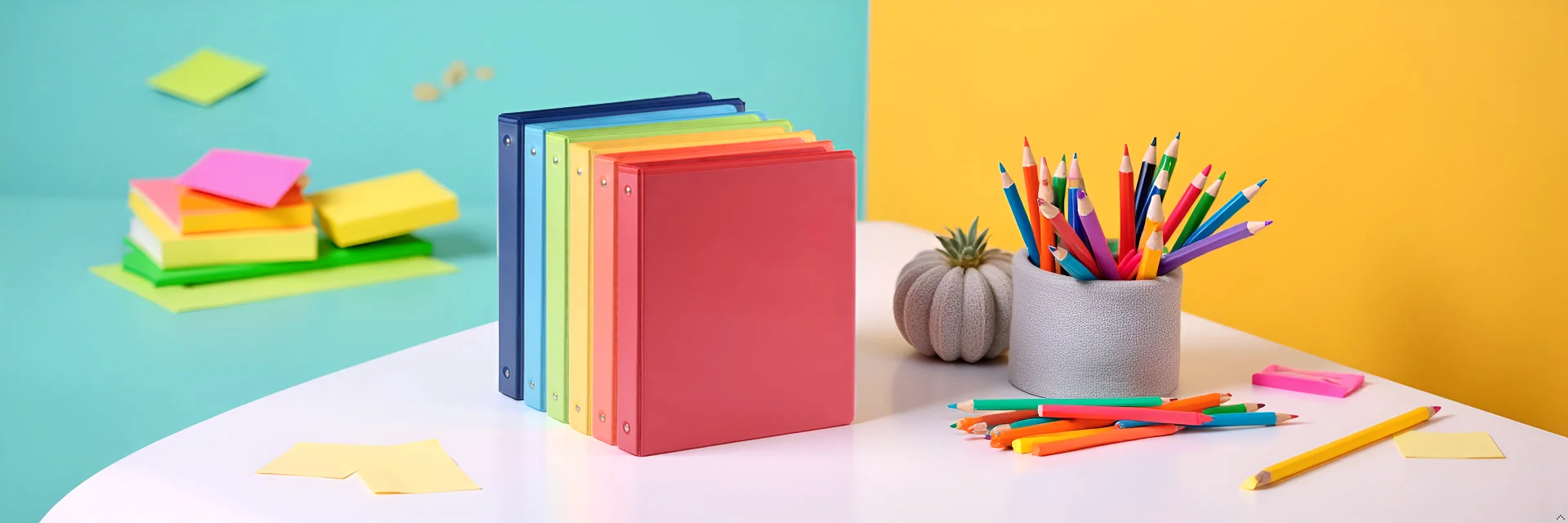
One color per subject, on everything that subject touches
Most color-coding plans fail at the folder, not the binder. A student picks a red binder for English in August, grabs whatever folder sits on top of the pile in October, and by November red no longer means anything. The fix is a rule with no exceptions: each subject gets one color, and that color goes on the binder, on its tab in any shared binder, and on its folder. Nothing else in the backpack wears it.
Pick colors that differ in hue or in depth, so a navy binder and a pale blue one still read as two subjects under a dim locker light. Our single-color 1-inch binders come in navy, red, Kelly green, pastel blue, pastel pink, pastel purple and several more, and our project folders come in blue, red, pastel mint, pastel blue, pastel pink and pastel purple. That is enough to match a six-subject schedule one to one. In a shared binder, give each subject the tab closest to its binder color.
| Subject | Binder color | Folder color | Tab in a shared binder | Behind the five tabs of its own binder |
|---|---|---|---|---|
| Math | Navy blue | Blue | Blue | class notes, problem sets, formula sheets, quizzes and tests, graded work |
| English | Red | Red | Red | reading notes, essay drafts, novel handouts, vocabulary quizzes, marked essays |
| Science | Kelly green | Pastel mint | Green | lecture notes, lab write-ups, lab sheets, unit tests, graded labs |
| Social studies | Pastel blue | Pastel blue | Light blue | lecture notes, reading responses, maps and timelines, tests, returned essays |
| Spanish | Pastel pink | Pastel pink | Pink | vocabulary notes, workbook pages, verb charts, quizzes, returned work |
| Art or elective | Pastel purple | Pastel purple | Purple | technique notes, assignments, project briefs, critiques, graded pieces |
The folder carries the subject's color to the places a binder never goes: the take-home packet, the permission form, the group project that lives at a friend's house for a week. Each of our folders has three prongs and two pockets. A punched handout can ride in the folder until Friday, then drop onto the binder rings without a second trip through the hole punch.

One binder per subject, or one shared binder with tabs
There are two ways to carry the same six colors, and the difference shows up on the shoulder and inside the rings. One binder per subject means a stack of slim 1-inch binders, each with its own 5-tab set. One shared binder means a single thicker binder with an 8-tab set and one tab per subject.
Our rule of thumb is to fill a binder to about 80% of its stated capacity so pages still turn, and to count each divider page as three sheets. A 1-inch binder holds 200 sheets, so about 160 in practice. Five dividers take 15 of those, which leaves each subject about 145 sheets of its own. A 2-inch binder holds 450, about 360 in practice, and eight dividers take 24. The 336 sheets left over, split six ways, come to 56 per subject.
That gap decides most cases. A shared binder suits short class periods, lockers at the far end of the building and younger students who lose track of six separate objects. Binders per subject suit block schedules, where three or four classes meet in a day and the rest stay home, and any course heavy enough to outgrow 56 sheets before the unit ends. The two also mix well: a shared binder for light subjects and a separate binder for the course that eats paper. Our binder size guide runs the same arithmetic for every ring size.
| Question | One binder per subject | One shared binder |
|---|---|---|
| What you carry | only the binders for today's classes | one binder, every day |
| Ring size | 1 inch: 200 sheets, about 160 in use | 2 inch: 450 sheets, about 360 in use, or 1.5 inch: 325, about 260 |
| Dividers | one 5-tab set per binder, 15 sheets of capacity | one 8-tab set, 24 sheets of capacity |
| Room per subject | about 145 sheets | about 56 sheets each across six subjects |
| Best for | block schedules, paper-heavy courses, high school | short periods, one bag a day, middle school |
Five tabs inside a subject binder, eight in a shared one
Inside a subject binder, five tabs cover nearly everything a class hands out: notes, homework, handouts, tests and returned work. Put them in the order they open. Notes go first because they open every class, homework second because it goes in and out daily, handouts third, tests fourth. Returned work sits at the back, where it can pile up without getting in the way of anything.
Our 5-tab heavy-duty dividers suit this binder well. The tabs are big enough to grab with a thumb, and the plastic does not tear at the rings the way paper dividers do. Each page also has a slim front pocket for about 10 to 15 loose sheets. Use the pocket on the homework divider for whatever is due next class, and what to hand in is visible at a glance.
A shared binder needs a different plan, because one tab per subject is the whole budget. With six subjects and an 8-tab set, two tabs are left. Give the first one to the schedule and the week's assignments, and the last one to blank loose-leaf paper, so nobody tears a page out of another subject's notes. Inside each subject section, notes stay on the rings in date order, homework due rides in the front pocket of that subject's divider, and returned work goes in the back pocket.
Do not skip the returned-work tab. Graded quizzes show exactly which problems cost points, and they are the first pages worth rereading before a final. A tab that only collects paper is clutter. This one becomes a study guide written by the teacher.
Labels you can read from across the room
Color shows which subject a binder belongs to. A label names the exact binder when two classes share a color, when a younger sibling inherits the system, or when twelve red binders sit on a classroom shelf. Our view binders carry a clear overlay on the front, the back and the spine, so labels slide in behind plastic instead of peeling off by March.
Print three pieces of paper per binder. The front sheet carries the subject, the student's name, the period and the teacher. The spine strip carries the subject in letters large enough to read from the door, because binders on a shelf stand spine out. The back overlay is free space: a unit list, the class schedule or the grading scale, whichever gets looked up most.
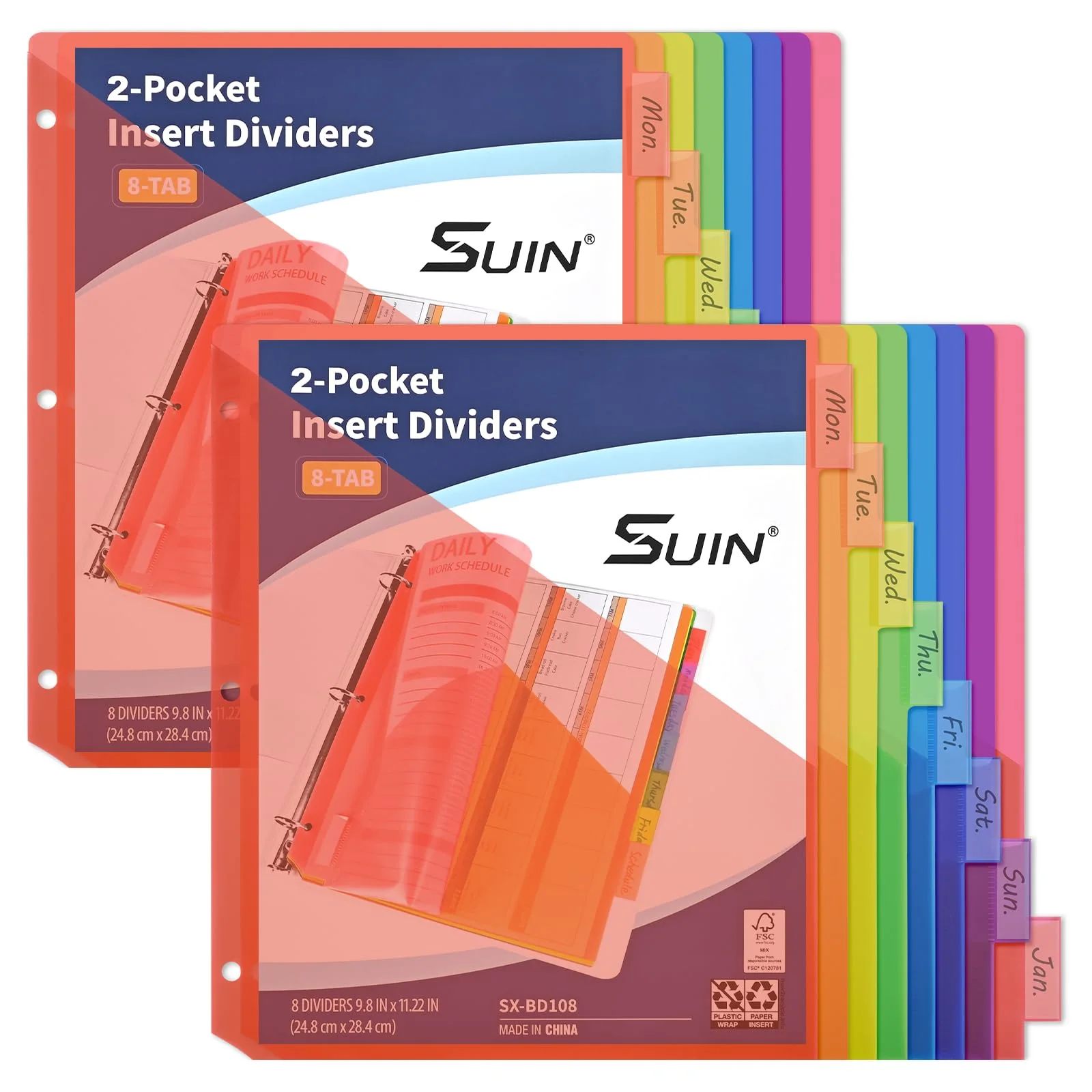
Tabs come in two kinds, and each has a place. Our 8-tab insertable dividers come with a sheet of cardstock inserts: write the subject, slide it into the clear tab and change it next year without scraping glue. Our heavy-duty 5-tab and 8-tab sets come with label stickers instead. A sticker holds through a year of a tab being yanked in and out, but it is final, so settle the tab order before peeling. For a binder that will be set up again every fall, choose inserts. For a binder that does one job until it is full, stickers do fine.
A clean label is a small version of that idea: it looks tidy on the shelf, and it saves a minute every time someone reaches for the wrong binder.
The Friday reset
Color-coding keeps working only when paper keeps moving. Ten minutes on Friday afternoon does it. Open each binder and empty both interior pockets. Every loose sheet ends up in one of three places: punched and filed behind its tab, moved into the subject's folder, or thrown out. A divider pocket that is full on Friday is doing the binder's job, so file what is in it.
Then move finished units out. When a unit test comes back, the unit's notes, handouts and the test itself leave the school binder for an archive binder at home. Use the same colors there: one archive binder per subject, or one large binder with an 8-tab set that matches the school tabs. The school binder stays light enough to carry, and the archive holds everything a final exam will ask about. A 1.5-inch or 2-inch binder with 325 or 450 sheets of capacity is the usual pick for the archive, since it stays on a shelf and never travels.
Some pages deserve longer care than one school year: a certificate, a reading award, a drawing worth framing someday. The U.S. National Archives lists ring binders among safe bindings for family papers and recommends sleeves of stable plastics such as polypropylene, polyester or polyethylene, with PVC on its list of materials to avoid. Our top-loading sheet protectors are acid-free and PVC-free, so those pages can go into the archive binder in a sleeve and stay there.
A family archive outgrows a shelf eventually. That is when one of our expanding hanging file folders, seven pockets with six color-coded dividers, takes over the oldest years in a file drawer.
Notes that fit the system
A binder tab sorts paper by subject. The page itself still needs a shape, and two study methods from the Academic Achievement Center at Kansas State University fit this system without new supplies.
Cornell notes split each page into three parts: the notes taken in class, a narrow column of key information pulled out after class, and a short summary written in your own words. Those pages live behind the notes tab, and the narrow column turns into a ready-made review sheet before a test. Filling the column and the summary is an after-class job, and the Friday reset is a good moment to catch any page still missing them.
It's not important to keep things perfect or clean.
Kansas State University Academic Achievement Center, on the notes taken in class
The Leitner System sorts flashcards into stacks that come up for review at different intervals, and K-State presents it as a method for regular, consistent study rather than cramming. Index cards fit neatly in a divider pocket. Keep each subject's stacks in the pocket of that subject's divider, and the vocabulary for Spanish stays with Spanish instead of drifting to the bottom of the backpack.
Ink can carry the color code onto the page too. Our erasable 0.7mm gel pens come in six ink colors, so headings can match the binder they sit in, and the friction eraser fixes a mistake without crumbs or correction tape. Two limits apply: the thermo-sensitive ink should not sit for long above 131°F (55°C), and erasable ink is never the pen for a signature or a permanent record. Sign the permission slip with the retractable black gel pen instead. Both live on our pens and markers shelf, and the pen and page guide matches each pen to the paper it suits.
The same system for a classroom or a family
A teacher can run the same rules with class periods in place of subjects. Give each period a color, then keep a binder per period in that color with the seating chart in the front overlay and the roster on the back. Work comes in through a project folder in the period color, so a stack of turned-in papers sorts itself before grading starts. The code can reach the whiteboard too: our chisel-tip dry-erase markers come in a 12-color assortment, enough to write each period's homework in its own color, and they wipe off laminated sleeves as well as boards. For a whole class of students, our 1-inch view binders come in packs of 12 and 36, and the 8-tab insertable dividers in sets of 12 and 36.
A parent can borrow the system with one change: a color per child instead of a color per subject. Each child gets a binder in that color for report cards, medical forms, camp papers and the school calendar, plus a folder in the same color that rides back and forth in the backpack. When a note comes home, it lands in that child's folder and gets filed on Friday with everything else.
A small office or home office works the same way, with a color per client or per project. The 6-pack of 1-inch view binders with two pockets gives six matching jobs a binder each, and the clear overlays carry the client name. The color-code planner on our home page lays out colors for any number of subjects, periods, children or clients, and the rest of the SUIN range fills in whatever the plan calls for.
Setup checklist
Most of this takes one evening in August and ten minutes a week after that. Work through the list in order, because each step depends on the one before it. Lay every binder, folder and divider set on the table first, so a missing color shows up before school starts and not on the first morning of classes.
- Write down every subject, period, child or client the system has to cover, and count them.
- Assign one color to each, keeping colors that look alike far apart, and write the plan on one sheet of paper.
- Choose one binder per subject or one shared binder, using 145 sheets per subject against 56 as the deciding figure.
- Buy the binder, the folder and the tab in each color, plus a 5-tab set per subject binder or one 8-tab set for a shared binder.
- Set the tabs in order: notes, homework, handouts, tests and returned work, or a schedule tab, the subjects and a blank-paper tab.
- Print the front sheet and the spine strip, slide them behind the overlays, and write or stick the tab labels.
- Put the first week's handouts behind their tabs and a small stack of Cornell note pages behind every notes tab.
- Set a Friday reminder: empty the pockets, file the loose paper and move finished units to the archive binder.

