
Which SUIN Pen for Which Page: Gel, Erasable, Fineliner or Dry-Erase
Your page decides the pen. See how tip size, paper weight and ink type play out in a journal, a binder, on black card and on a whiteboard, then match each SUIN pen to the surface it suits.
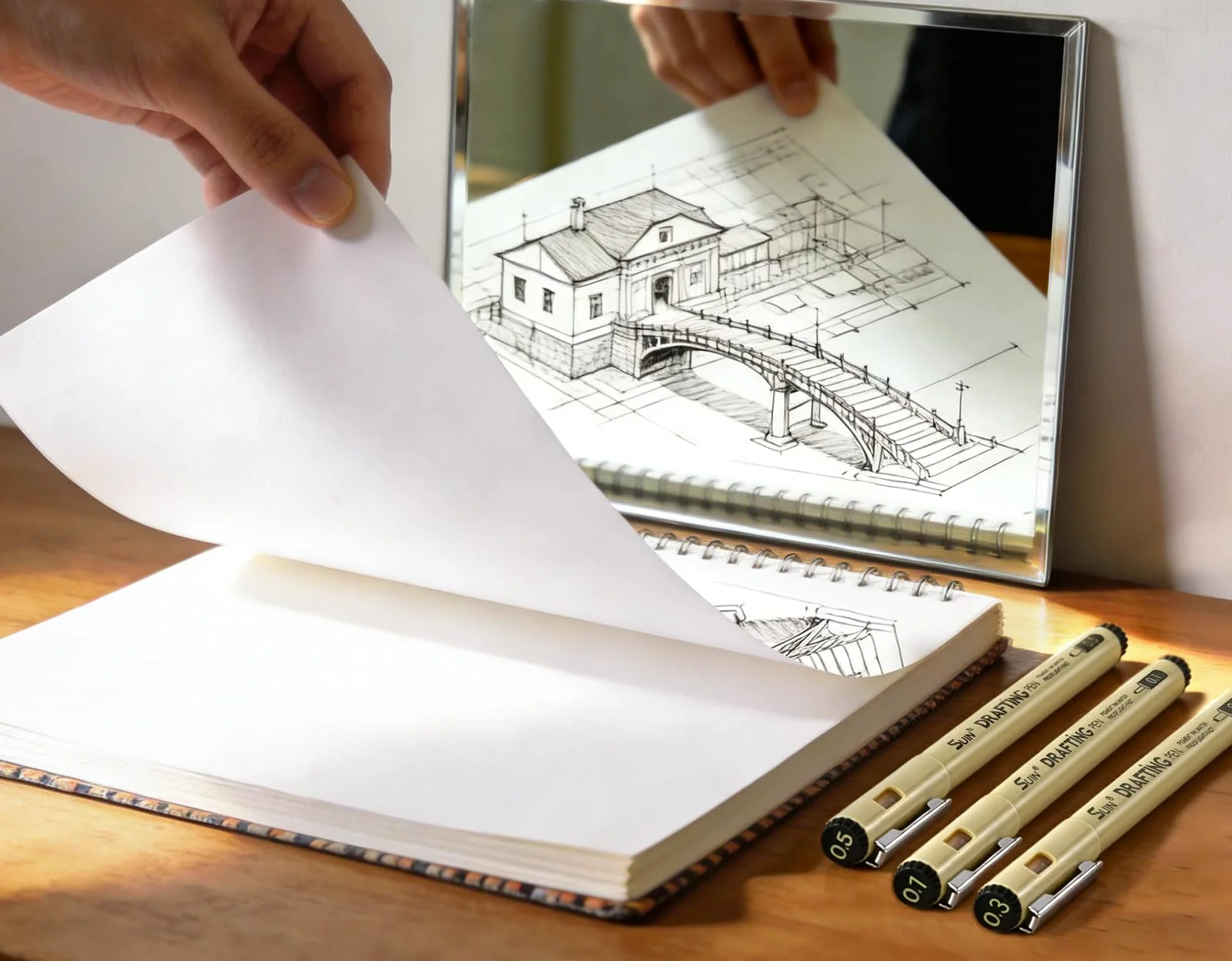
What 0.7mm means on the page
The number printed on a gel pen is the size of the ball at its tip, and 0.7mm is the size most people know as a medium point. On paper it draws a line dark enough to read at arm's length and thin enough to keep small letters open. That balance matters more in a lined A5 journal than on a letter page. An A5 page measures 5.5 by 8.3 inches, the margins are narrow, and a broader point fills the loops of an e or an a before the word is done.
Line width also decides how long a page stays wet. A bigger ball lays down more ink, so the line sits on the surface longer, and a left-handed writer drags a palm across it sooner. Our retractable gel pens are 0.7mm with black ink that dries quickly, so we hand them to fast writers first. The erasable gel pens are 0.7mm as well, so a page written with both reads as one hand.
The metallic pens step up to 1.0mm on purpose. On black paper a thin gold line disappears into the dark, and a broader tip gives the shine room to show. The chisel dry-erase markers go further still, because a whiteboard is read from the back of a room rather than from a desk.
Start, then, with the page you use most. Daily notes in a journal, a stack of copy paper in a binder, a sheet of black cardstock and a classroom board each ask for a different line. Once the page is named, the pen almost picks itself.
Paper weight, show-through and the last-page test
Paper weight is given in gsm, grams per square meter: the weight of one square meter of a single sheet. A heavier sheet is a denser sheet, and wet ink has more fiber to settle into before anything reaches the back. Light paper shows two faults. Bleed-through is ink that soaks right through and marks the reverse. Ghosting, also called show-through, is quieter: no ink crosses, yet the words on the far side show as a shadow and fight with whatever you write there next.
Our A5 notebook is built around this. It holds 160 pages of 100gsm cream paper, acid-free, made for gel pens, fineliners and fountain pens. We chose the cream tone because it is easier on the eyes than bright white over a long session of journaling, and a black line still reads cleanly on it.
Paper and pen meet in your hand, though, not on a spec sheet, and no two pens lay down ink the same way. So we recommend a habit before you fill a new notebook: test on the last page. Write a line with each pen you plan to use. Add a few strokes of the brush tip and a small block of solid ink, wait a minute, then turn the page over. If the back shows nothing you can read, that pen is fine on both sides of the sheet. If it shows a shadow, keep it for headings or for one side of the spread.
The same test works on our 200-page lined journal, whose paper weight we do not state, and on any notebook from the notebooks and journals shelf. One test page out of 160 or 200 is a small cost next to a spread you care about.
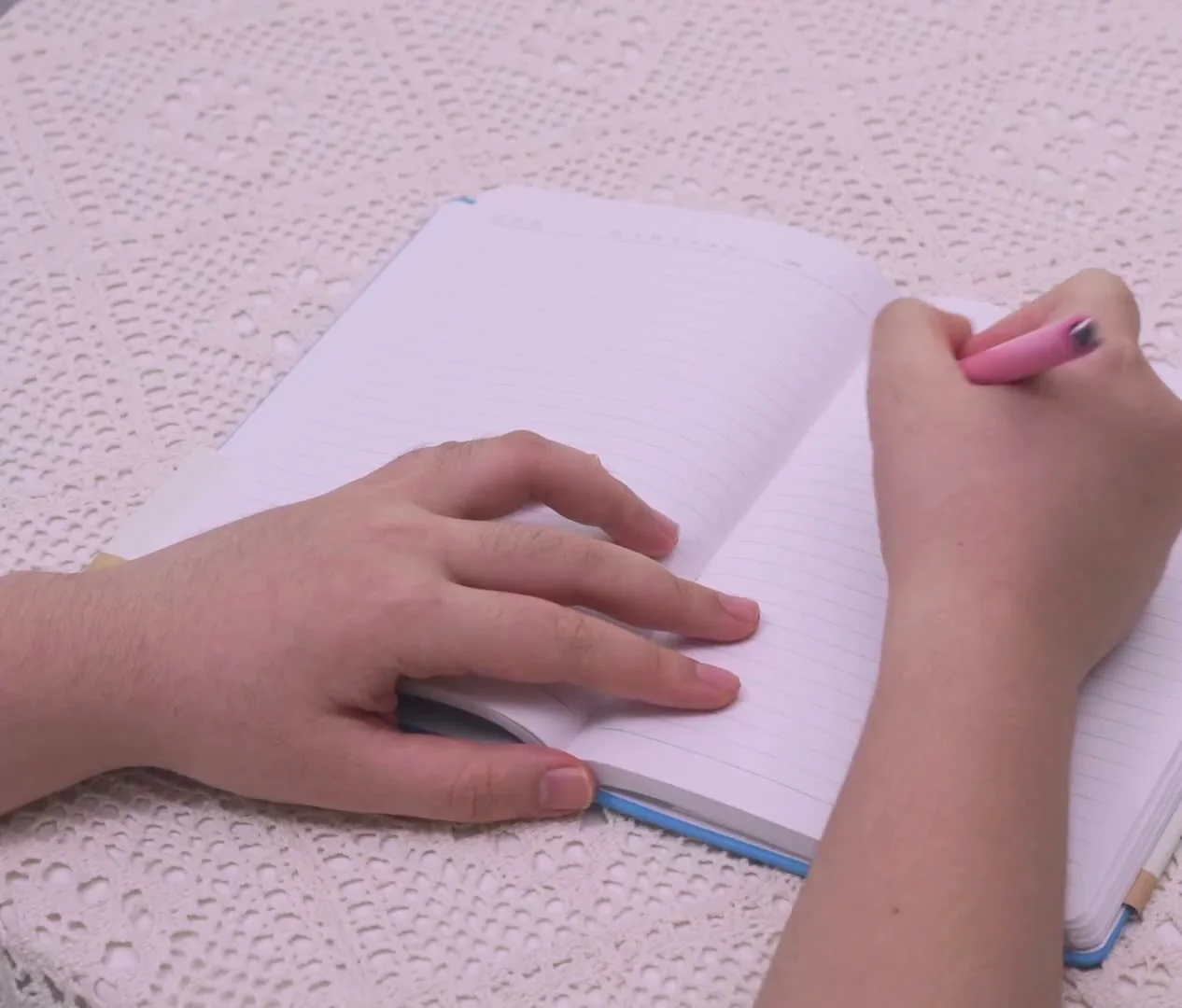
Gel pens with refills for daily notes
Lecture notes, meeting notes and the running to-do list wear out pens faster than anything else. For that work a retractable gel pen is the least fuss: a click opens it, there is no cap to lose in a bag, and the clip holds it to a notebook cover or a pocket. Our retractable set comes as five pens in pastel barrels, every one writing black, with five refills in the same box.
The refills matter more than the barrels. When a pen runs dry halfway through an exam, swap the cartridge and keep the grip your fingers already know. That grip is a long, soft silicone sleeve, and on a day of heavy writing it is the part your hand notices.
Copy paper in a binder is the other daily page. Letter sheets from a printer are usually lighter than journal paper, so write a test line on a spare sheet and look at the back before you fill a whole set. If the line shadows through, write on the front of each sheet only. Single-sided notes suit a binder anyway: a page can move to another section without splitting a thought across its reverse.
When those pages outgrow a folder, our 3-ring binders hold letter paper on rings from half an inch to two inches. Our article on what size binder you need turns a stack of notes into a ring size, so the binder still closes in May.
Erasable gel: heat, cold and what never to write
The erasable pens look and write like ordinary 0.7mm gel pens. The difference sits in the ink, which is thermo-sensitive: it turns clear when it warms. The rubber cap on the end of each pen is a friction eraser. Rub it over a word and the friction heats the ink until the color goes, with no crumbs, no correction tape and no scuffed paper left behind.
That same property sets the limits. Store the pens and the pages at room temperature, and keep them away from prolonged heat above 131°F, or 55°C. A car parked in the sun or a page left near a heater is where this bites, because heat there does the eraser's work across the whole page.
Faded writing is not always lost. Let the page come back to room temperature first and look again. If the words stay faint, our temperature notice says cold can recover them: below 0°F for 20 to 30 minutes.
Now the rule that matters most. Never use erasable ink for signatures, checks, contracts or any record that has to stay as written. Ink that heat can clear can be cleared on purpose by someone else, and the paper keeps no trace of the change.
Inside those limits the pens earn their place. Planners, homework drafts, worked math and schedules that keep shifting are their pages. The six-color set comes in packs of 6 to 24 pens with refills included, and the six inks line up with subjects the way our guide to color-coding binders for school sets them out. A black, blue and red version covers plain note-taking.
Fineliners, pigment ink and the ASTM D-4236 label
Fineliners belong to drawing, hand lettering, ruled bullet-journal spreads and technical sketches. Our black set pairs micro tips for detail with a flexible brush tip that widens the stroke as you press. The ink is pigment, waterproof and fade-resistant once dry, and for that reason we point people to these pens for pages they mean to keep. On 100gsm paper a micro tip draws a crisp edge. The brush tip puts down far more ink, so give it the last-page test before you letter a title across a spread.
The pack also carries a line that many people read past: conforms to ASTM D-4236. It comes from federal law. The U.S. Consumer Product Safety Commission explains that under the Labeling of Hazardous Art Materials Act, art materials need a toxicological assessment at least every five years. They must also carry a statement of conformance, whether or not a hazard is found.
"Conforms to ASTM D-4236"
U.S. Consumer Product Safety Commission
ASTM D4236 itself is the practice for building the precautionary label from a toxicologist's review of the product. So the line on the pack tells you the ink went through that review and is labeled according to it. It is not a wider promise, and the standard says plainly that a label alone does not take every risk out of using a product. Read any caution printed on the pack, and put the cap back on when the drawing is done.
For a teenager starting a bullet journal, the useful kit is short: one notebook with heavy paper, a micro tip for grids and text, and the brush tip for headings. Everything on the pens and markers shelf carries its tip size and ink on the card, so matching a pen to that kit takes a minute.
Gold on black paper, markers on boards
Ordinary ink vanishes on black paper. Our metallic gel pens in gold, silver and white use an opaque ink that sits on top of a dark sheet instead of sinking into it, through a 1.0mm tip broad enough to carry the shine. Use them for card making, for headings in a black-page journal, for labels on dark cardstock and for highlights over a fineliner drawing. Opaque ink lays down more body than a 0.7mm line, so let a page dry fully before you close the book on it. Each pen has a cap, and capping it between strokes keeps the tip from drying out.
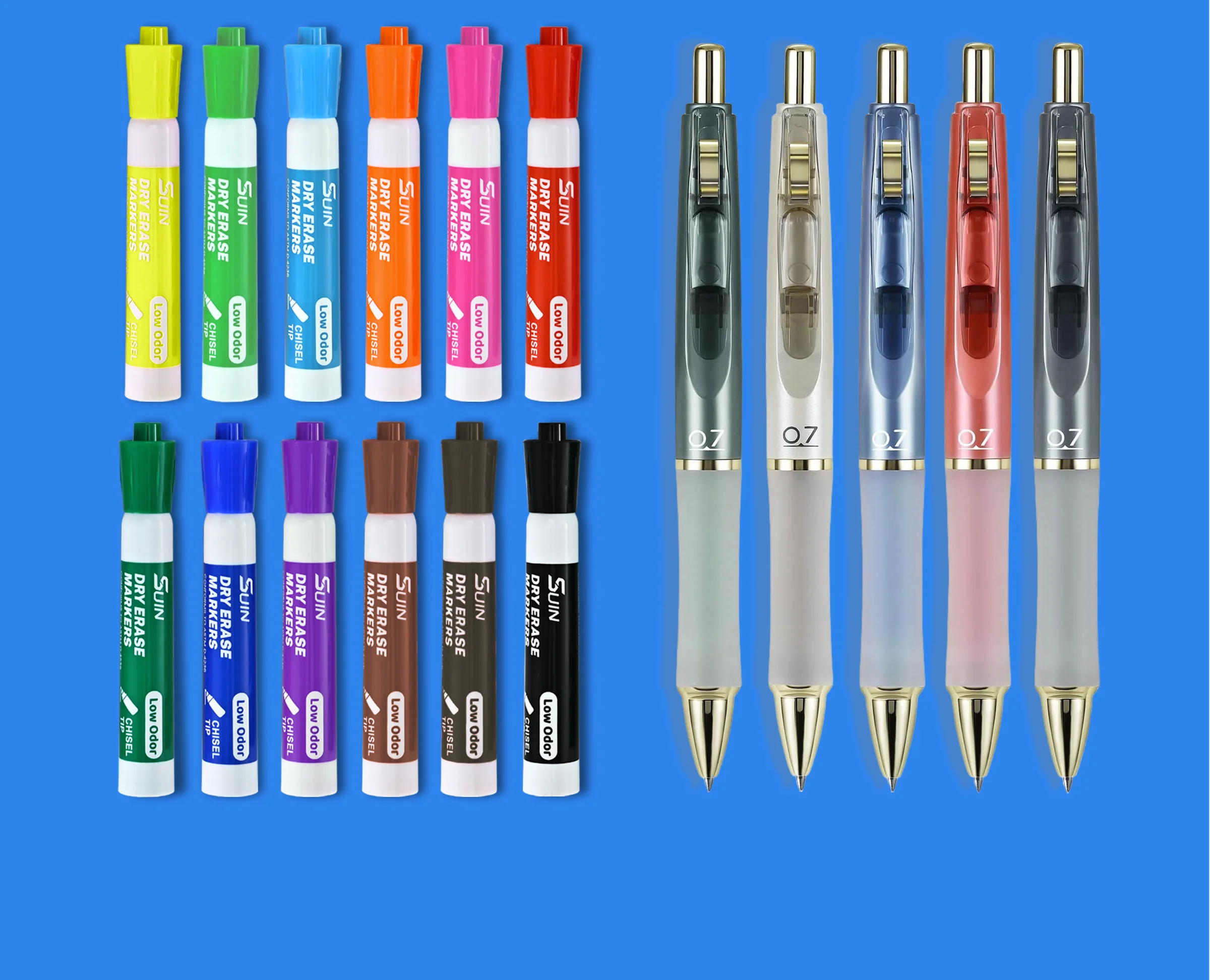
Dry-erase markers work on a different kind of surface altogether: smooth and non-porous, where ink rests on top and wipes away. Our chisel-tip markers have two working edges. Hold the broad side flat for bold headers about 5 to 7mm wide, and turn the pen to the narrow edge for lines of 1 to 2mm. They wipe off whiteboards, glass boards, mirrors and laminated paper sleeves. That last surface is the teacher's trick. Slide a worksheet into a laminated sleeve and the same page takes answers all week.
The slim markers come in nine colors with a medium fine tip on a thin barrel. They suit planning boards, glass doors and mirrors. Keep both kinds off plain paper, where the ink soaks in and stays.
| Pen | Tip | Ink | Best on | Avoid |
|---|---|---|---|---|
| Retractable gel pen | 0.7mm | Black gel, refillable | Daily notes, journals, copy paper | Light paper written on both sides without a test |
| Erasable gel pen | 0.7mm | Thermo-sensitive gel, 6 colors or black, blue, red | Planners, drafts, homework | Signatures, checks, records, heat above 131°F / 55°C |
| Fineliner | Micro tips and a brush tip | Black pigment, waterproof | Drawing, lettering, bullet journals, pages you keep | Brush tip on thin paper without a test |
| Metallic gel pen | 1.0mm | Opaque gold, silver, white | Black paper, dark cardstock | Closing the page before it dries |
| Chisel dry-erase marker | 5 to 7mm broad side, 1 to 2mm edge | Dry-erase | Whiteboards, glass, mirrors, laminated sleeves | Paper and other porous surfaces |
Acid-free paper for notes you keep for years
Some pages are written to be thrown away, and some are meant for a shelf: a travel journal, a first year of teaching, the notes behind a thesis. For those, the paper matters as much as the pen. The Library of Congress explains that acid, whether from the paper itself or from its surroundings, breaks down the cellulose in paper when moisture is present. Its preservation bulletin adds that acid in older papers speeds their decay, and it defines permanent paper as paper that lasts several hundred years under normal use and storage.
Our 100gsm notebook pages are acid-free, so a journal written in them starts without the acid that drives that decay. Pair them with ink that stays put. The pigment fineliners are waterproof and fade-resistant, and black gel from the retractable pens suits everyday records. Leave the erasable pens out of anything you plan to keep.
Storage does the rest. The Library of Congress advises keeping works on paper cool, dry and out of strong light, with acidic papers kept apart from the rest so their acid cannot migrate. At home that means a shelf away from a sunny window and a radiator, and no yellowed old clippings tucked into the back pocket of a journal you value.
Loose pages kept in a binder need the same care. Our sheet protectors and pocket dividers are acid-free and PVC-free, and they sit on the dividers and sheet protectors shelf. A sheet in a protector counts as about three sheets when you work out how full a binder can get. Our own rule is to stop at about 80% of the stated capacity so the pages still turn.
Match your pen to your page
The choice comes down to four questions, asked in order:
- What is the surface? Paper, black card, a board or a laminated sleeve each rule out half the pens at once.
- How heavy is the paper? On 100gsm paper, gel and fineliner use both sides. On copy paper, test first and write single-sided if the ink shadows through.
- Will the page change? Erasable gel suits drafts and plans, and nothing that needs a signature.
- How long will it last? For pages you keep, use acid-free paper and pigment or black gel ink, and store them cool, dry and dark.
| Surface | The SUIN pen that suits it | Tip |
|---|---|---|
| 100gsm journal page | Retractable gel pen or black fineliner | 0.7mm, or micro tip and brush |
| Copy paper in a binder | Retractable gel pen, front side only if it shadows | 0.7mm |
| Black paper or dark cardstock | Metallic gel pen in gold, silver or white | 1.0mm |
| Whiteboard or glass | Chisel-tip or slim dry-erase marker | 5 to 7mm broad side, 1 to 2mm edge, or medium fine tip |
| Laminated sleeve | Chisel-tip dry-erase marker | 1 to 2mm edge for answers |
Put together, a working kit for school or the office stays short. A retractable black gel pen covers notes and copy paper. An erasable set takes the planner and the drafts that keep changing. A fineliner looks after the pages you keep, and a chisel marker handles the board. Add the metallics only when black paper is part of your week.
Write one line with each new pen on the last page before anything else. If you would rather answer the questions with a few taps, the pen and page guide among the home page tools asks the same four and points to a pen. The pens, journals and binders in the SUIN catalog are made to share one desk, so a notebook from one shelf and a pen from another meet on the same page.

