
What Size Binder Do I Need? SUIN Ring Sizes by Sheet Count
Count your paper once, add the sleeves and the tabs, and pick a ring that still turns its pages at the end of the term. From a loose stack on the desk to the right SUIN binder takes five steps and one sum.
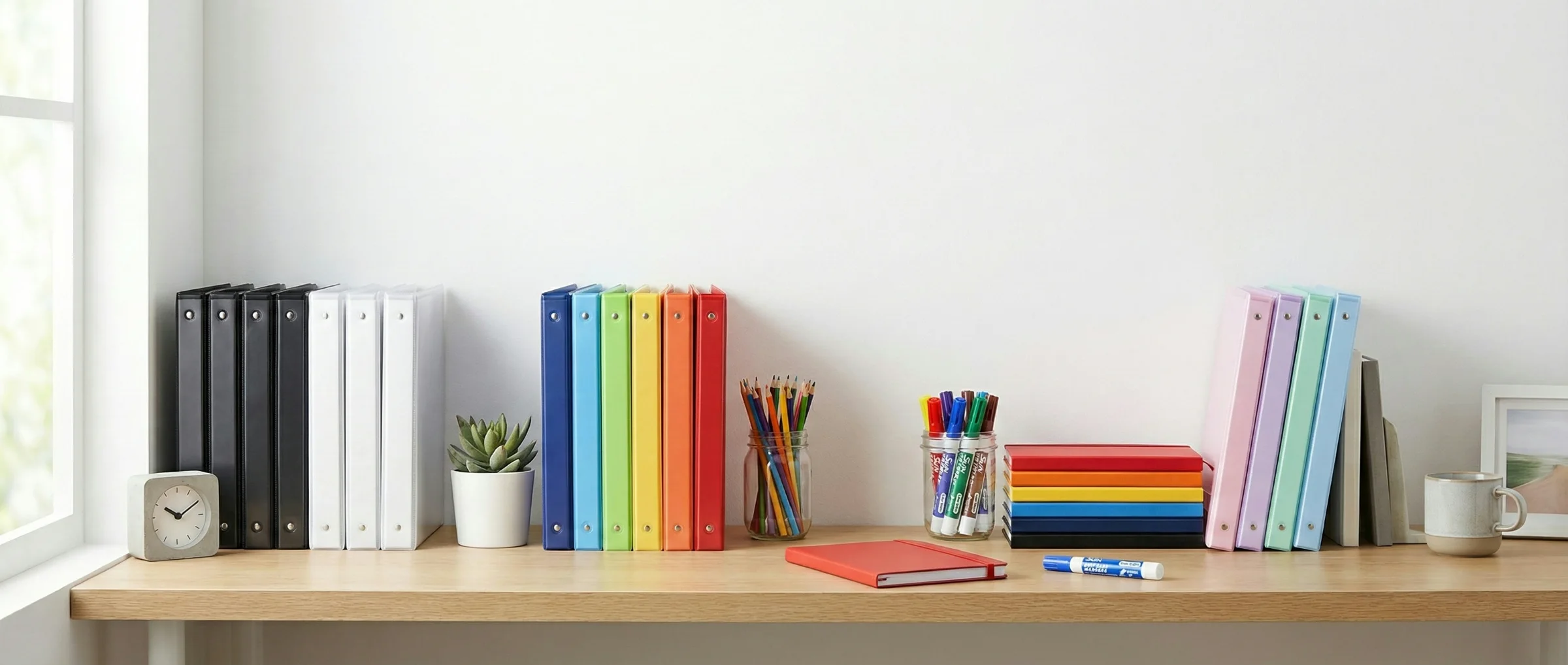
Start with the stack, not the ring
Most binders get picked by eye: someone stands in an aisle, weighs a 1 inch against a 2 inch, and guesses. The better start is the paper itself. It might be a semester of lecture notes, a year of tax forms, a box of recipes waiting for sleeves, or the planning pages a teacher carries from August to June. Count the sheets, or measure the stack with a ruler and estimate. Then read that number against the capacity we state for each SUIN binder, because a ring size means nothing until it is tied to pages.
Our stated capacities run in clean steps for letter paper, the 8.5 by 11 inch page that measures about 215 by 280 mm. A 0.5 inch ring holds up to 100 sheets. A 1 inch ring holds up to 200. The 1.5 inch clear view and durable binders hold up to 325, and a 2 inch ring holds up to 450. Those are full loads, the point where the rings close around paper with nothing to spare.
That is why the third column below matters more than the second. It shows how much to plan for in each size if the pages should still turn at the end of the year.
| Ring size | Stated sheets | Plan for at 80% | What it typically holds |
|---|---|---|---|
| 0.5 inch | 100 | 80 | One unit, a short project, a meeting packet |
| 1 inch | 200 | 160 | One class for a term, a household tax year |
| 1 inch expandable spine | 175 | 140 | One subject carried every day in a backpack |
| 1.5 inch | 325 | 260 | A full course with handouts, 80 recipes in sleeves |
| 2 inch | 450 | 360 | A reference manual, a teacher's year of plans |
| 1 inch mini, 5.5 x 8.5 inch pages | 200 | 160 | A planner, a recipe card book, a home budget |
The last column is a starting point, not a promise. Pages printed on one side, thin handouts and heavier cardstock all take different room, so your own count beats any typical figure. If the stack is still growing, plan on the next size up.
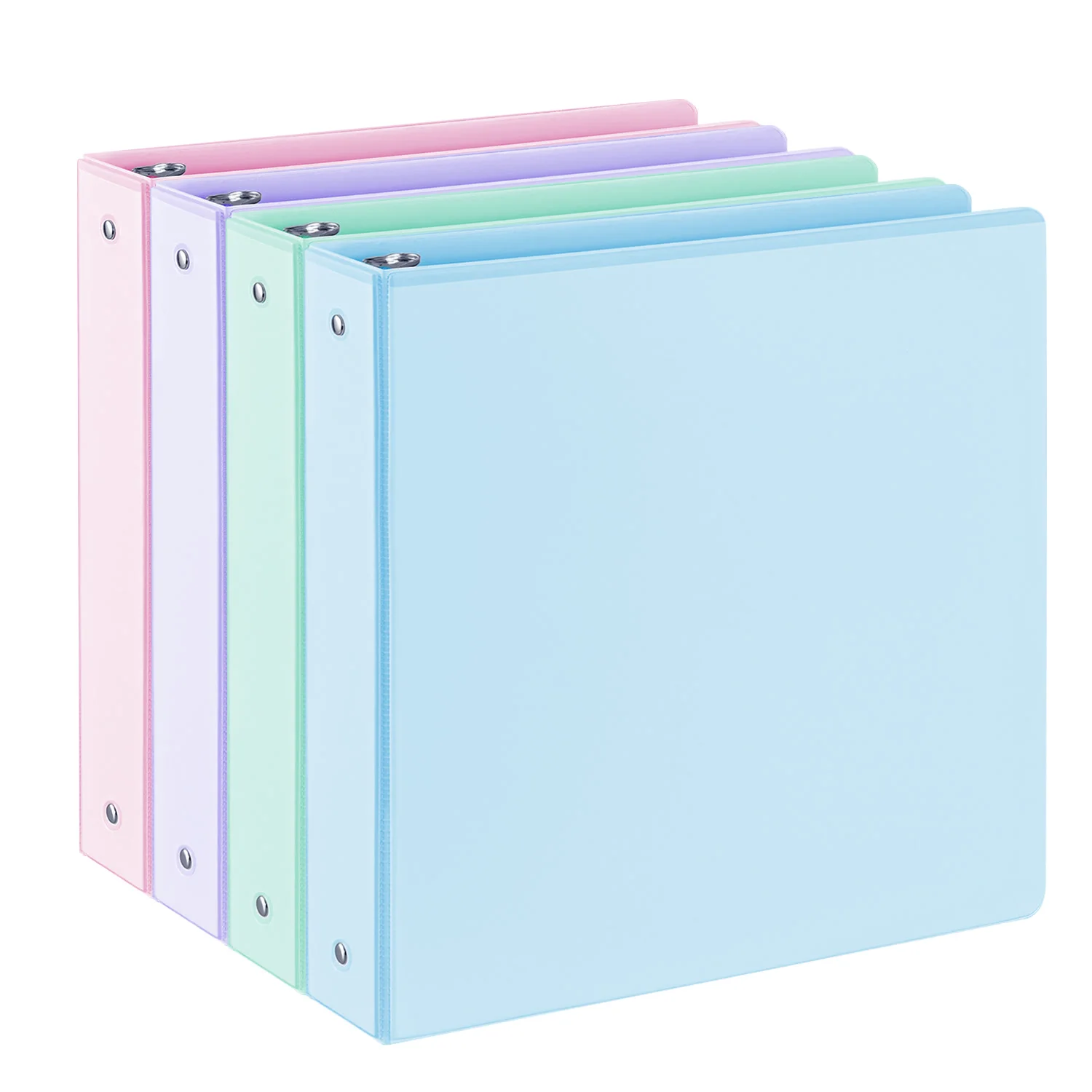
The clear view set comes in 0.5, 1.5 and 2 inch rings, so one family of covers can carry a short unit, a full course and a binder that stays on the shelf all year. Each one has clear overlays on the front, back and spine for a title page, and two inside pockets for handouts nobody punched.
Why we stop at 80 percent
The 80 percent figure is our rule, not an industry standard, and it comes from how a binder behaves near its limit. At full capacity the rings close around a solid block. The last pages press against the curve, the holes take strain every time a page turns, and adding one more handout means prying open the rings on a packed stack. Leave a fifth of the space empty and the pages fan around the ring instead of fighting it.
Round rings make the most of that room. A round ring is a circle, so every page travels the same path as it turns, and an open binder splits its stack across both covers and settles flat on the desk. A flat page is one you can copy from, write on or photograph without pinning it down with your other hand. Rings that close without a gap give the edge of a sheet nothing to catch on, and the round rings in our mini A5 binders are built that way.
There is a second reason for the margin: paper arrives in waves. A teacher hands out a packet in week six, a bank mails a corrected statement in March, a friend gives you twelve recipes at once. A binder planned at 80 percent takes those arrivals in stride, with no trip back to the store.
The arithmetic works both ways. Multiply a stated capacity by 0.8 to see what a binder should carry. Or divide your own count by 0.8 to find the capacity you need: a stack of 160 sheets calls for a binder rated for 200, and a stack of 260 calls for one rated for 325. If the number lands between rows, round up.
Sheet protectors and dividers count three times
A loose sheet is one sheet. Slide it into a sheet protector and it stops being one: the sleeve has a front, a back and a reinforced strip along the holes, and together they take about the room of three sheets. Our rule counts a protector with its page as 3 sheets, and a divider page as 3 sheets too. It is a planning rule of ours, not a measurement printed on the box, and it leans toward leaving room.
That multiplication is where most binders go wrong. A recipe collection of 80 pages in sleeves is 240 sheet-thicknesses before a single tab goes in. A 1 inch binder rated for 200 sheets looks generous for 80 recipes, and it will not close.
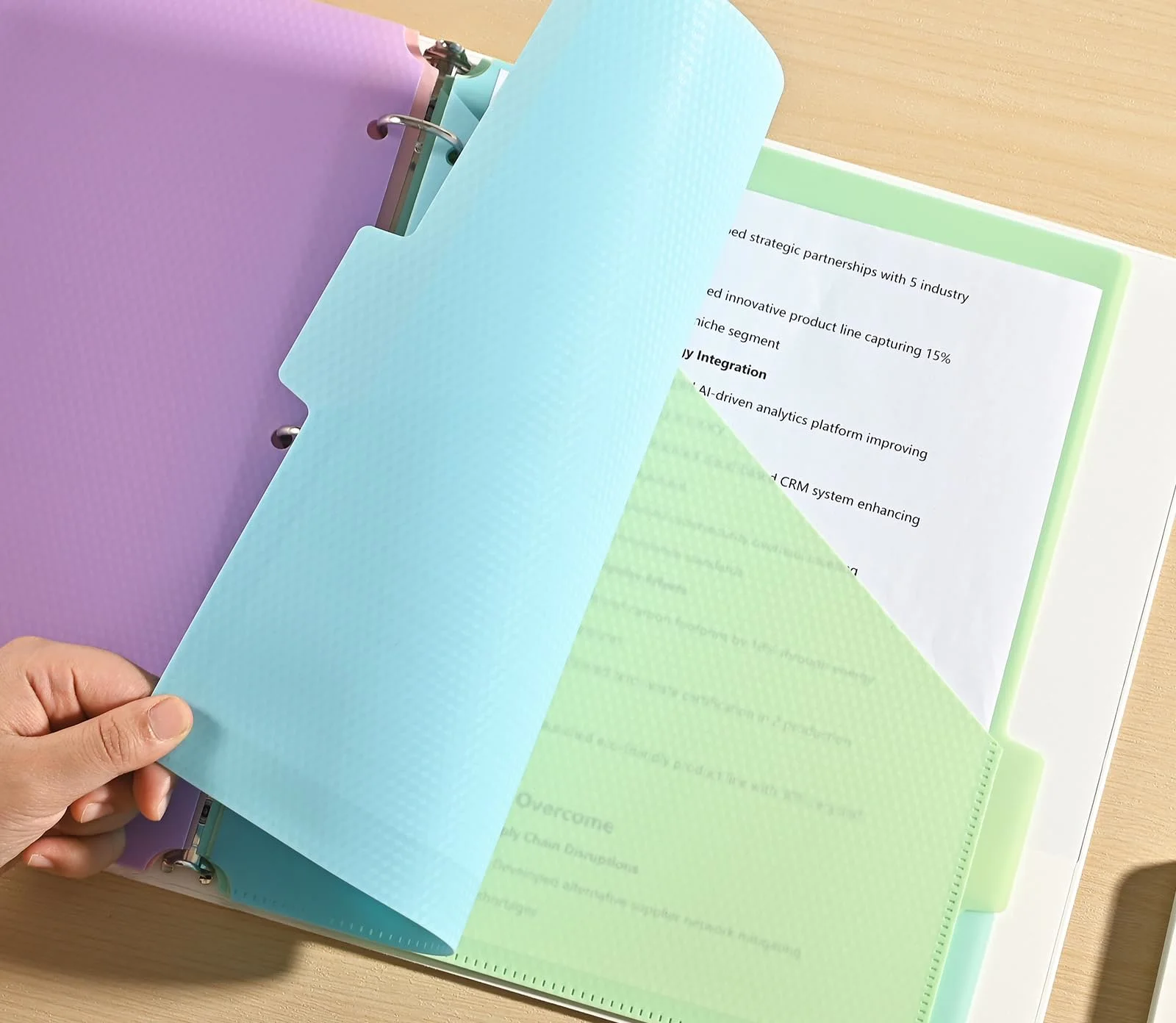
Pocket dividers add a layer on top. Our heavy-duty pocket dividers hold about 10 to 15 sheets in each front pocket, and those sheets count like any other page. If every pocket of an 8-tab set will carry receipts or a permission slip, add them to the total before you choose.
Four common stacks show how fast the count climbs. Each row adds plain sheets, sleeves times three and divider pages times three, then takes the smallest ring whose 80 percent figure covers the total.
| Stack | Sheets | Sleeves (x3) | Divider pages (x3) | Total | Ring size |
|---|---|---|---|---|---|
| Semester of lecture notes | 150 | 0 | 5 = 15 | 165 | 1.5 inch (plan 260) |
| Household tax year | 90 | 10 = 30 | 8 = 24 | 144 | 1 inch (plan 160) |
| Recipe collection | 0 | 80 = 240 | 5 = 15 | 255 | 1.5 inch (plan 260), 2 inch if it grows |
| Teacher's planning binder | 200 | 20 = 60 | 8 = 24 | 284 | 2 inch (plan 360) |
Look at the semester row. The notes alone fit a 1 inch binder, yet five divider pages tip the total past 160 and into the next size. The binder size finder on our home page runs the same arithmetic if typing the numbers suits you better than adding them. Sleeves and tabs in every count live on the dividers and sheet protectors shelf.
Four stacks, worked through
The semester binder is the one people undersize most often. A student sees 150 pages of notes, buys a 1 inch binder rated for 200, and adds a 5-tab set in week two. The tabs push the count to 165, past the 160 we plan for, and by finals the rings are stiff to close. A 1.5 inch binder carries the same course with almost a hundred sheets to spare for handouts that have not arrived yet.
A tax year runs the other way. Ninety sheets of statements and forms, ten sleeves for receipts that would otherwise slip out past the holes, and an 8-tab set for income, housing, medical and the rest come to 144. That fits a 1 inch binder with room left over, and next year's papers start in a fresh binder on the shelf beside it.
Recipes are the stack that surprises. Eighty pages in protectors and five tabs for courses total 255, right at the edge of a 1.5 inch binder. If friends keep adding cards, step up to 2 inch now. Our top-loading protectors have a checkered finish that cuts glare from indoor lights, so a recipe reads clearly on the counter while the sleeve keeps spills off the page.
A teacher's planning binder is the heaviest of the four. Two hundred sheets of plans, 20 sleeves for master copies that should never be written on, and an 8-tab set by month or unit add up to 284, which calls for 2 inch. Handouts headed out the door travel better in project folders with prongs than loose in a bag. To give each subject its own cover color as well, the guide to color-coding binders for school walks through a full set.
Spine width and where the binder lives
The ring size measures the inside of a binder, and the outside is always wider. Our 1 inch bulk binders have a 1.7 inch spine, since the cover has to wrap around the ring mechanism and still close over a full load. Before buying for a particular shelf or backpack sleeve, measure that space against the spine, not the ring.
A binder that travels every day needs a different answer from one that sits still. In a backpack, a half-empty 2 inch binder takes the same room as a full one and adds weight for nothing. The expandable-spine binder solves that from the other side.
Its 1 inch spine opens out to hold up to 175 letter sheets when full and pulls back in when the binder is nearly empty, so September's binder is slim and May's binder still closes. Under our 80 percent rule, that means planning for 140 sheets. The plastic covers fold back a full 360 degrees, which turns the binder into a flat writing surface on a lap or a bus seat. The four colors in the pack, red, blue, sky blue and black, give four subjects four covers you can tell apart from across a room.
A binder that lives on a shelf earns its place through the spine label. Our view binders carry a clear overlay on the spine, so a printed insert turns a row of black or white binders into a set of labeled volumes. The durable round ring binders come ten to a pack in 1.5 or 2 inch, black or white, for an office shelf where every spine should match. The full lineup sits on the 3-ring binders shelf.
Two smaller binders, or one big one
One 2 inch binder plans for 360 sheets. Two 1 inch binders plan for 320 between them, and for many stacks that small loss buys a lot. Split a school year into fall and spring and only half of it rides in the bag each day. Split a household file into this year and last year, and the old one moves to a high shelf. Split a shared project between two people and nobody waits for the binder.
The single big binder still wins when the paper is one reference read in any order: a procedures manual, a full year of lesson plans, a family recipe book. Splitting those means guessing which half holds the page you need, and guessing wrong in front of a class or a stove costs more than the extra inch of spine.
Half-size work is its own case. Our mini A5 binders are made for 5.5 by 8.5 inch pages, and their 1 inch round rings hold up to 200 sheets, so plan on about 160. They suit planners, recipe cards and home budgets, and they fit in a backpack beside the textbooks.
Bound pages are the other half-size answer. An A5 journal does without rings altogether, and our 200-page lined journal lays flat, closes with an elastic band and keeps loose notes in a back pocket. Both formats suit someone who writes on the go, and the journals sit on the notebooks and journals shelf.
Papers you keep for years
Some binders are not for this term. Tax records, certificates, a child's drawings and a grandmother's recipe cards can stay in a binder for a decade or more, and here the material matters as much as the ring size.
The U.S. National Archives lists ring binders among the safe ways to bind an album, with sleeves made of stable plastics such as polyester, polypropylene or polyethylene. The same guidance names PVC as a material to avoid, and the agency's rehousing guide says a product containing polyvinyl chloride should never be used. The Library of Congress gives similar advice for photographs: polypropylene enclosures are suitable, and they let a print be viewed without taking it out.
Several of our binders are made PVC-free: the 1 inch clear view binder in single colors, which names polypropylene as its material, the pastel view binders, the mini A5 binders and the durable 10-pack. Our sheet protectors are acid-free and PVC-free, and so are our pocket dividers.
Acid is the slower threat. The Library of Congress explains that acids, whether from the paper itself or from what surrounds it, break down the cellulose in paper when moisture is present. Keep acidic papers such as newspaper clippings in their own sleeves rather than pressed against a recipe card. Then store the binder somewhere cool, dry and out of strong light. A closet shelf in the living space beats an attic or a damp basement.
Choose a ring with room to spare here too. A page squeezed against a full ring creases at the holes every time it turns, and a crease in a certificate you need twenty years from now does not come out.
A five-step plan for the right binder
The whole method fits on an index card, and it gives the same answer whether you work it on paper or in your head.
- Count the plain sheets in the stack. A rough count is fine for a first answer.
- Count the sheet protectors and multiply by 3, count the divider pages and multiply by 3, then add anything that will ride in divider pockets.
- Divide the total by 0.8 and pick the smallest ring whose stated capacity reaches that number: 100, 200, 325 or 450 sheets.
- Decide where the binder lives. For a daily backpack, look at the expandable spine or two smaller binders. For a shelf, measure by the spine.
- For papers kept for years, choose a PVC-free binder with acid-free, PVC-free sleeves, and store it cool and dry.
Label the spine before the first page goes in. A binder with a name on its spine goes back to the right place on the shelf, and a binder sized with room to spare stays easy to open all year.
Avoid overstuffing albums.
U.S. National Archives and Records Administration
Binders in every ring size from 0.5 to 2 inch, sleeves and tabs are part of the SUIN collection, so the stack on your desk and the binder that holds it can come from one place. If the next question is what to write with, the guide to which pen suits which page picks up where the binder leaves off.

